
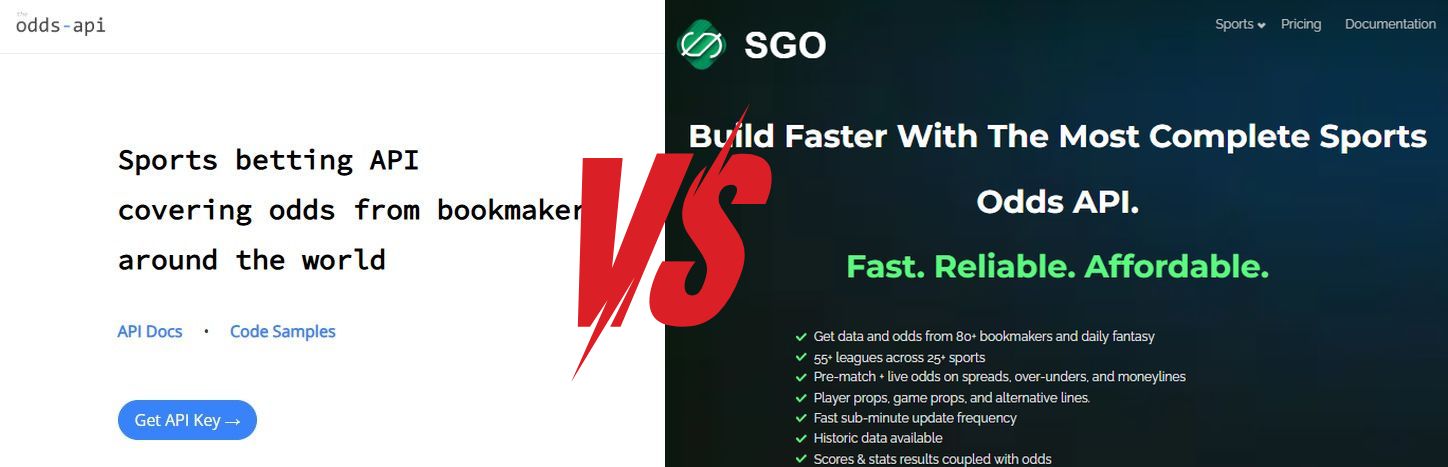
The Odds API vs SportsGameOdds
When building a sports betting application, analytics platform, or EV tool, selecting the right odds API provider is a critical technical and business decision. Two prominent options in this space are The Odds API and SportsGameOdds (SGO). Both deliver reliable sportsbook odds data, but they differ significantly in their pricing models, data delivery methods, market coverage, and overall architectural approach.
This comprehensive Odds API comparison examines both platforms across all key dimensions to help you make an informed decision based on your specific use case.
A Comprehensive Comparison: The Odds API and SportsGameOdds
The Odds API, the original Odds API, positions itself as a straightforward, developer-friendly service focused on simplicity and predictability. It uses a credit-based pricing model with a REST-only polling workflow, making it easy to understand costs and integration requirements upfront.
SportsGameOdds, leading Sports Odds API, takes a more comprehensive approach, positioning itself as an end-to-end sports data solution. It combines odds, scores, results, and optional WebSocket streaming with an object-based billing model designed for applications that need high data density per request.
Neither approach is inherently superior—the right choice depends entirely on your application’s data consumption patterns and feature requirements.
1. Pricing Models & Cost Structure
The Odds API
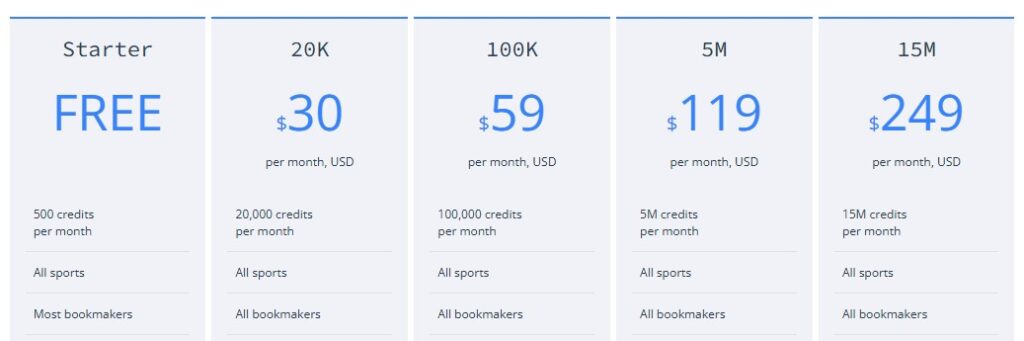
Billing Model: Credit-based system where each API request consumes credits based on event-market combinations.
- Critical detail: 1 credit = 1 event-market pair
- Example: 10 NFL games with 100+ markets each = 1,000+ credits per query
- Free tier: Available for testing and small-scale projects
- Starter package ($30/month): 20,000 credits per month
- Important limitation: Credits expire quickly with regular polling of comprehensive market data
Cost Example: If you query 10 NFL games (100 markets per game) every 15 minutes:
- Each query = 1,000 credits (10 games × 100 markets)
- 4 queries per hour × 24 hours = 96 queries/day = 96,000 credits/day
- Your monthly 20,000 credits would be exhausted in approximately 5 hours
Best for: Applications that poll a small subset of specific markets (e.g., just moneylines or spreads) or infrequently, OR those with significantly higher monthly budgets for comprehensive market coverage.
SportsGameOdds
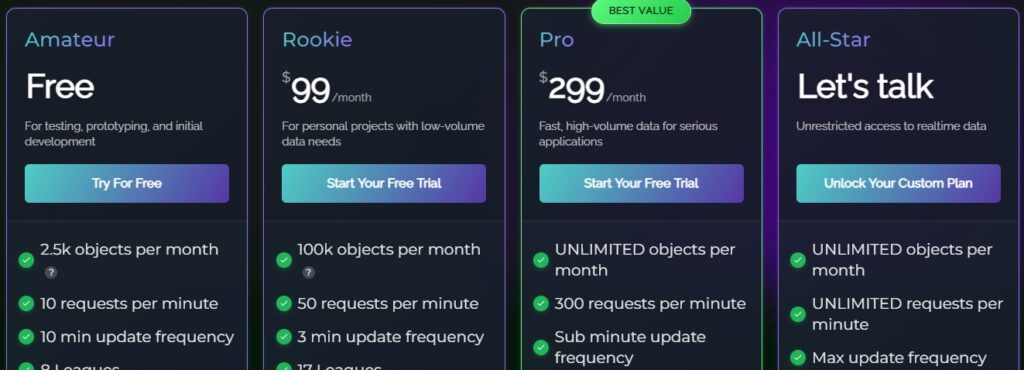
Billing Model: Object-based system where usage is calculated by the number of top-level objects (events) returned, regardless of market quantity.
- Critical detail: 1 credit (object) = 1 event, NOT 1 event-market
- Example: 10 NFL games with 100+ markets each = only 10 credits, regardless of how many markets or odds are returned
- Free tier: Available for testing
- Starter package ($99/month): 100,000 objects (events) per month
- Cost efficiency: No per-market multiplication—you pay only for unique events
Cost Example: If you query the same 10 NFL games every 15 minutes:
- Each query = 10 credits (10 games, regardless of market count)
- 4 queries per hour × 24 hours = 96 queries/day = 960 credits/day
- Your monthly 100,000 credits would last approximately 104 days (3+ months)
Best for: Applications that need comprehensive market data (multiple bookmakers, many markets, alternate lines) per event, or those making frequent polling requests.
Pricing Verdict
- For lightweight, selective polling: The Odds API’s $30/month starter could work if you only query 1-2 specific markets per event
- For comprehensive, frequent polling: SportsGameOdds’ $99/month starter is dramatically more economical—you get 5x more credits AND they don’t multiply by market count, making it potentially 50-100x better value for data-heavy applications
- Real-world comparison: The same polling pattern that exhausts The Odds API’s monthly credits in 5 hours would use only ~1% of SportsGameOdds’ monthly allocation
- Cost-per-event: SportsGameOdds’ flat-rate-per-event model makes it far more suitable for applications requiring broad market coverage
2. Real-Time Updates & Data Delivery
The Odds API
Delivery Method: REST API polling only (no WebSocket support documented)
Update Frequency:
- Publishes explicit update interval tables by market type
- Featured markets update faster than long-tail markets
- In-play updates are faster than pre-game updates
- Sub minute updates are achievable through the REST API for high-frequency scenarios
- Developers control update frequency by choosing polling intervals
Transparency: The level of documentation around update frequencies makes expectations very clear upfront.
SportsGameOdds
Delivery Method: REST API with optional WebSocket streaming
Update Frequency:
- REST API: Sub-minute updates
- WebSocket: Available on All-Star/custom plans for real-time push notifications
Typical WebSocket Workflow:
- Fetch initial snapshot via REST
- Subscribe to specific events via WebSocket
- Receive push notifications only when events change
Transparency: Public documentation describes sub-minute frequency but does not publish detailed interval tables per market type.
Real-Time Verdict
- For low latency requirements: The Odds API’s and SportGameOdds are on par.
- For efficient real-time architecture: SportsGameOdds’ WebSocket streaming reduces unnecessary polling, saves bandwidth, and is ideal for dashboards, alerts, and event-driven applications
- For documentation clarity: Both have excellent documentation, with SportGameOdds offer AI Vibe coding guide to get started quickly.
3. Sports Coverage & Market Depth
The Odds API
Sports Coverage:
- Wide range of sports including major leagues (NHL, NBA, NFL, MLB, soccer, etc.)
- Strong coverage for standard betting markets
Market Depth:
- Supports various betting markets including player props and alternate lines
- Notable limitation: Player prop coverage is primarily focused on US sports and US bookmakers
- May be less comprehensive for deep player props or niche alternative markets (e.g., “Shots on Goal 1+/2+” type props)
- Update frequency varies by market category (clearly documented)
Odds Formats: Decimal and American formats supported
Bookmaker Coverage: Integrates with “several” bookmakers (exact number not prominently specified)
SportsGameOdds
Sports Coverage:
- Broad spectrum of sports and events ((NHL, NBA, NFL, MLB, College Sports, soccer, etc.)
Market Depth:
- Explicitly covers betting odds and player props across various sports
- Uses explicit opt-in for alternate lines (
includeAltLines=true) - Emphasizes returning many alternates per event without additional usage cost (thanks to object-based pricing)
- Supports period/segment markets (league dependent)
- General player prop coverage (not limited to US markets)
Bookmaker Coverage: Claims to aggregate data from 80 bookmakers, providing extensive global coverage
Coverage Verdict
- For US-focused applications: Both work well.
- For global coverage: SportsGameOdds’ 80-bookmaker integration and broader player prop coverage give it an advantage
- For market depth per event: SportsGameOdds’ object-based pricing makes pulling comprehensive market data more economical
- For niche/deep props: SportsGameOdds may offer better coverage, though verification for specific sports is recommended
Get SportsGameOdds Discount Codes & Coupons in 2026
4. Data Scope: Odds Only vs. End-to-End Solution
The Odds API
Primary Focus: Odds delivery
- Primarily designed for delivering betting odds data
- Does not include scores, results, or settlement data
- Ideal if you already source these from other providers or don’t need them
SportsGameOdds
Comprehensive Data Package:
- Live scores integrated alongside odds
- Final results for settled events
- Team and player statistics (for supported leagues)
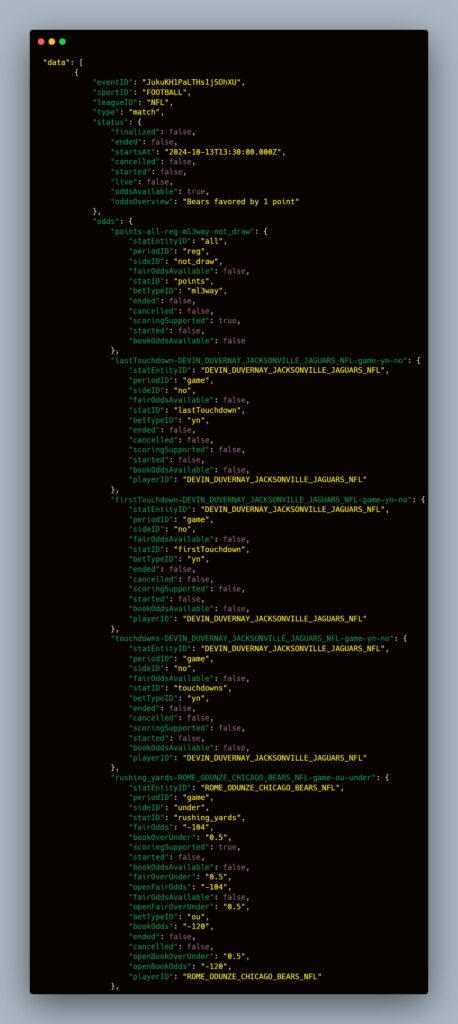
- Market-level scoring fields to help determine winning outcomes
- Some markets include a
scoringSupportedflag to indicate settlement reliability - Positions itself as a more complete, end-to-end sports data solution
Data Scope Verdict
- For odds-only needs: The Odds API is focused and efficient
- For all-in-one solution: SportsGameOdds reduces integration complexity by providing odds, scores, results, and grading-style data from a single provider
- For settlement/grading workflows: SportsGameOdds’ built-in result and scoring data is a significant advantage
5. Developer Experience & Integration
The Odds API
Integration Approach:
- REST API with clear, straightforward documentation
- Simple polling-based workflow
- Predictable credit consumption model makes usage forecasting easy
- Well-suited for developers who want a clean, focused API
SDKs: Not explicitly highlighted or prominently available
SportsGameOdds
Integration Approach:
- REST API with comprehensive documentation
- Optional WebSocket streaming for advanced use cases
- Official SDKs are available to facilitate easier integration across different programming languages
- Supports both polling and event-driven architectures
- AI Vibe Coding for sports odds
SDKs: Explicitly provides official SDKs, which can significantly reduce development time
Developer Experience Verdict
- For simplicity: The Odds API’s straightforward REST-only approach is easier to understand initially
- For rapid development: SportsGameOdds’ official SDKs can accelerate integration
- For architectural flexibility: SportsGameOdds supports both polling and streaming patterns
6. Use Case Recommendations
Choose The Odds API if you:
- Only need specific, limited markets (e.g., just moneylines or spreads, not comprehensive market coverage)
- Poll infrequently or at long intervals (e.g., once per hour or less)
- Want simple, predictable pricing with clear credit usage for selective queries
- Value clearly documented update intervals and transparency
- Need sub-second latency for high-frequency applications requiring minimal markets
- Are building a true MVP or side project with minimal market requirements
- Focus primarily on US sports and bookmakers
- Don’t need scores, results, or settlement data (sourcing elsewhere)
- Prefer a REST-only polling architecture
- Have predictable, low-volume query patterns that won’t exhaust credits quickly
Ideal for: Single-market comparison tools, niche market focus, developers querying only 1-2 specific markets per event, applications with infrequent polling requirements, budget-conscious side projects
Not ideal for: Applications requiring comprehensive market coverage, frequent polling of multiple markets per event, or data-heavy use cases (credits will deplete rapidly)
Choose SportsGameOdds if you:
- Pull comprehensive market data (multiple markets, bookmakers, or alternate lines per event)
- Poll frequently (every 15 minutes, hourly, or more often)
- Want object-based pricing that doesn’t multiply costs by market count (1 event = 1 credit, regardless of markets)
- Need scores, results, and bet-grading helpers in one platform
- Want optional WebSocket streaming for real-time, event-driven updates and reduced polling overhead
- Require global bookmaker coverage (80 bookmakers vs. “several”)
- Need comprehensive player props across multiple regions and sports
- Value official SDKs for faster development
- Are building a production-scale sports betting, trading, or analytics platform
- Plan to scale your application without worrying about credit multiplication
Ideal for: Data-heavy applications, live betting platforms, comprehensive sports analytics engines, multi-bookmaker arbitrage tools, international audiences, applications requiring frequent polling of broad market data, production trading systems
Superior value if: You’re querying 10+ games with 50+ markets per game, polling more than once per hour, or need comprehensive coverage—SportsGameOdds becomes exponentially more cost-effective.
| Feature | The Odds API | SportsGameOdds |
|---|---|---|
| Pricing Model | Credit-based (per event-market) | Object-based (per event only) |
| Starter Package | $30/month (20,000 credits) | $99/month (100,000 objects) |
| Cost per 10 Games, 100 Markets | 1,000 credits/query | 10 credits/query |
| Monthly Query Budget at Starter | ~20 queries (if 1,000 credits/query) | ~10,000 queries (if 10 credits/query) |
| Update Speed | Sub-second (REST polling) | Sub-minute REST, real-time WebSocket |
| Delivery Method | REST only | REST + WebSocket streaming |
| Bookmaker Coverage | Several bookmakers | 80 bookmakers |
| Player Props Focus | Primarily US sports/bookmakers | Global coverage |
| Alternate Lines | Supported, varies by market | Explicit opt-in, no additional cost |
| Odds Formats | Decimal & American | Standard formats |
| Scores & Results | ✗ Not included | ✓ Included |
| Settlement Data | ✗ Not included | ✓ Market-level scoring fields |
| Official SDKs | Not highlighted | ✓ Available |
| Update Documentation | ✓ Explicit interval tables | General sub-minute description |
| Best For | Single/dual-market polling | Comprehensive multi-market polling |
Final Recommendations
Both The Odds API and SportsGameOdds are production-ready, reliable platforms used by developers worldwide. However, the pricing structure difference is far more significant than initially apparent—it should be your primary decision factor.
Key Decision Framework:
Choose The Odds API if:
- You’re querying only 1-2 specific markets per event (just moneylines, spreads, or totals)
- You’re polling very infrequently (hourly or less often)
- Your needs are truly minimal in scope
Get the odds API Discount Codes 2026
Choose SportsGameOdds if:
- You’re querying multiple markets, bookmakers, or alternate lines per event
- You’re polling frequently (every 15 minutes, hourly, etc.)
- You want comprehensive market coverage without your costs skyrocketing
Real-World Example:
If you’re polling 10 NFL games with 100+ markets every 15 minutes:
- The Odds API: Exhausts 20,000 monthly credits in ~5 hours = completely impractical
- SportsGameOdds: Uses only ~1% of 100,000 monthly credits = highly economical
Before Making Your Final Decision:
- Calculate your actual query pattern: How many events? How many markets per event? How frequently will you poll?
- Plug your numbers into each pricing model: This is the most important decision factor
- Try both free tiers to evaluate real-world performance and data quality
- Review official documentation for your specific sports and markets
- Consider future scale—will your usage patterns change as you grow?
- Evaluate integration complexity for your tech stack (SportsGameOdds offers official SDKs)
The Bottom Line:
For selective, minimal queries, The Odds API can work at $30/month. However, for any application requiring comprehensive market data or frequent polling, SportsGameOdds’ $99/month starter is dramatically more economical—potentially 50-100x better value depending on your query patterns. Don’t let the higher starting price fool you; the per-event billing model makes it far superior for data-heavy use cases.