
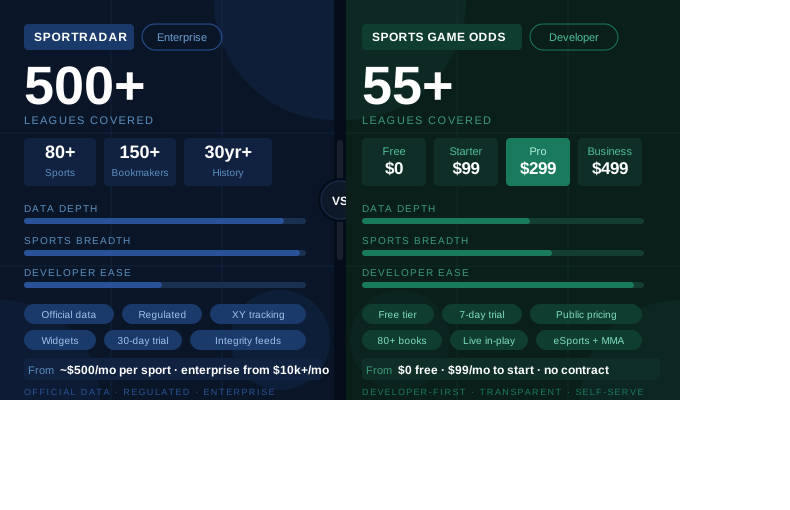
Sportradar vs Sports Game Odds
When you start looking for a sports data API, two names will surface quickly regardless of what you are building: Sportradar and Sports Game Odds (SGO). On the surface they both offer odds data and sports coverage, but the comparison is less straightforward than it appears. Sportradar is one of the oldest and most deeply entrenched data providers in the industry, powering everything from broadcast graphics to regulated sportsbooks. Sports Game Odds is a leaner, developer-focused odds aggregator built for teams that want to move fast without navigating a six-figure enterprise contract.
This guide breaks both platforms down across every dimension that matters, so you can figure out which one actually fits what you are trying to build.
Quick Summary: Who Are These APIs For?
Sportradar is the industry benchmark for official sports data. It holds direct data rights agreements with the NFL, NBA, MLB, NHL, and dozens of other leagues and federations worldwide, which means its data is not just aggregated from external sources but collected and verified at the source. Its client list reads like a who’s who of the sports industry: DraftKings, FanDuel, ESPN, Sky Sports, BetMGM, and major regulated operators across Europe and Asia. That depth of coverage and those official relationships come at a cost, though. Pricing is custom, contracts are long-term, and there is no self-service path to production access.
Sports Game Odds (SGO) is a developer-first odds aggregation API aimed at startups, indie developers, and growing teams. It does not hold official league data rights, but it aggregates real-time odds from 80 or more bookmakers across 55 or more leagues, offers a permanent free tier, transparent public pricing, and a seven-day trial on paid plans. You can read the documentation, sign up, and have data in your application before ever speaking to anyone.
1. Pricing
This is where the gap between these two providers is most visible, and for many developers it is where the decision effectively gets made.
Sportradar Pricing
Sportradar does not publish a public price list. All contracts are custom, negotiated directly based on the data packages you need, the leagues and sports covered, your geographic usage rights, and your expected call volume. Industry estimates based on community reports and third-party comparisons suggest that entry-level single-sport contracts typically start somewhere between $500 and $1,000 per month, while multi-sport enterprise deals can run to $10,000 or more per month with annual commitments. There is no month-to-month option and no self-service production plan.
That said, Sportradar does offer something the previous API in this series does not: a genuine free trial. You can create an account on their developer portal, select the products you want to test, and get a 30-day trial key immediately, with no purchase required. The trial is limited to 1,000 total calls and one query per second, and it covers non-commercial testing only, but the data itself is the same real-world production data you would receive as a paying customer.
Sports Game Odds Pricing
SGO uses transparent, publicly listed pricing built around an “objects” billing model. Each event returned in an API response counts as one object, and all bookmakers and markets within that event are included at no extra cost. This is a meaningful advantage over per-call or per-market models that can make it difficult to predict your monthly bill.
Paid tiers run from approximately $99 to $499 per month billed annually, with a permanent free Amateur tier available regardless of whether you upgrade. All paid plans include a seven-day trial. The structure makes cost estimation straightforward from day one.
| Verdict: Sportradar’s 30-day trial is a genuine plus and sets it apart from other enterprise providers. But once you move to production, pricing is opaque and contracts are long-term. For teams with clear budget and scale, that is workable. For everyone else, SGO’s transparent tiered pricing is far more predictable and accessible. |
2. Data Type: Official vs Aggregated
This is arguably the most important distinction between the two APIs, and it is one that gets overlooked in surface-level comparisons.
Sportradar
Sportradar holds official data rights agreements with many of the world’s most prominent leagues and federations, including the NFL, NBA, MLB, NHL, UEFA, and dozens more. This means the data does not just come from monitoring external sources: in many cases it is collected by Sportradar’s own scouts and technology directly at the venue, verified in real time, and delivered to clients as the authoritative feed for that league.
For regulated operators, this matters enormously. Many jurisdictions require that licensed sportsbooks use official data feeds for bet settlement and live pricing. If you are building a product in a regulated market, Sportradar is often not just preferable but legally necessary.
Sports Game Odds
SGO is an aggregator. It collects and normalises odds from 80 or more sportsbooks and delivers them through a single API. This is extremely useful for odds comparison tools, EV calculators, arbitrage scanners, and most developer-facing use cases. What it does not provide is officially licensed league data. If your application requires data that can be used for bet settlement in a regulated jurisdiction, or if you need official roster, injury, or play-by-play data as it is generated live at the venue, SGO is not the right tool.
| Verdict: If official data rights matter for your use case, whether for regulatory compliance, broadcast integration, or data accuracy guarantees, Sportradar is in a category of its own. For odds aggregation and most consumer-facing betting tools, SGO’s aggregated data is more than sufficient. |
3. Sports and League Coverage
Sportradar
Sportradar covers 80 or more sports across 500 or more leagues, tracking over 750,000 events per year. That includes every major North American professional league, global football at every level from the Premier League down to regional second divisions, cricket, rugby, tennis, golf, NASCAR, eSports, and more. The sheer breadth is unmatched. It also offers league-specific API formats for the NFL, NBA, MLB, NHL, and other major leagues, providing the greatest possible depth of coverage tailored to each sport’s data structures.
Sports Game Odds
SGO covers 25 or more sports across 55 or more leagues, including NFL, NBA, MLB, NHL, soccer, tennis, MMA, eSports, horse racing, motorsports, handball, and water polo. That is a strong selection for most production use cases, particularly those focused on North American and European markets. It will not cover the long tail of regional leagues that Sportradar reaches, but for the vast majority of betting and odds-focused platforms, the coverage is more than adequate.
| Verdict: Sportradar wins decisively on breadth, covering more than eight times as many leagues. For global media platforms or products that need to cover niche international competitions, that scale matters. For most betting tools and analytics platforms, SGO’s 55-plus league coverage hits the sports that actually drive traffic. |
4. Market Types and Data Depth
Sportradar
Sportradar’s data library goes well beyond odds. Here is a snapshot of what it covers:
- Pre-match and live in-play odds from 150 or more bookmakers
- Player props, futures, and outright markets
- Consensus odds aggregated across books
- Probabilities (live and pre-match win, lose, draw)
- Real-time scores and play-by-play data
- Advanced player tracking statistics including XY coordinate data
- Betting splits showing public money and bet percentage trends
- Historical data going back 30 or more years for select leagues
- Integrity monitoring and fraud detection feeds
- Official images, editorial content, and embeddable widgets hosted by Sportradar
That last category is worth calling out specifically. Sportradar is not just a data API: it is a full content platform. If you are building a media product, the ability to pull official player headshots, live match trackers, and editorial content through the same integration is a genuine differentiator.
Sports Game Odds
SGO is focused squarely on the odds layer. Its core offering includes:
- Pre-match moneylines, spreads, and totals
- Alternate spreads and totals
- Player props and game props
- Live in-play odds via a real-time data stream
- Closing odds, useful for model calibration and validation
- Scores and settlement results built into the same API response
What SGO does not cover is futures markets, player tracking data, integrity monitoring, official images or editorial, or the kind of deep statistical archives that Sportradar maintains. For a straight odds aggregator, that is entirely fine. For anything that needs to go beyond odds, Sportradar’s additional data layers become relevant.
| Verdict: Sportradar has a significantly deeper data library, particularly in advanced statistics, media content, and integrity feeds. For pure odds aggregation and betting tools, SGO covers the essentials cleanly and without unnecessary complexity. |
5. Real-Time Performance and Latency
Sportradar
Sportradar’s infrastructure has been built and refined over more than two decades, and it shows. The platform delivers data at millisecond latency for its official league feeds, which is one of the reasons regulated sportsbooks rely on it for live bet settlement. It supports both RESTful pull endpoints and Push (streaming) endpoints for real-time delivery, with data returned in JSON or XML. API keys are governed by a rolling 30-day quota and a query-per-second limit that varies by product and package.
Sports Game Odds
SGO offers a real-time data for live odds with sub-minute update frequency for pre-match markets, and SSE streaming on higher-tier plans. For odds comparison dashboards and EV tools, that cadence is entirely workable. For live in-play applications where pricing needs to track market movements in real time, the update speed is sufficient for most consumer-facing products.
| Verdict: Both APIs are fast enough for the majority of production use cases. Sportradar holds an edge for applications requiring millisecond-level official data for live bet settlement. For everything else, SGO’s real-time stream is more than capable. |
6. Developer Experience
Sportradar
Sportradar’s developer experience has improved considerably in recent years. Its developer portal is publicly accessible without an account, documentation is well structured across league-specific and general sport APIs, and the 30-day free trial is self-serve, meaning you can sign up, grab a trial key, and start making calls without talking to sales first. That is a meaningful step ahead of many enterprise providers.
The limitations kick in at the production stage. Moving from trial to production requires a formal contract, and the onboarding process involves legal review and negotiated order forms. Sportradar also explicitly positions its APIs as a B2B service not intended for direct client-side calls, which means the integration model assumes a server-side architecture. Some enterprise customers also note that the sheer volume of available products and packages can make it difficult to know which combination you actually need.
Sports Game Odds
SGO is explicitly designed to be developer-first. Documentation is publicly accessible without creating an account, the free tier requires no credit card, setup takes roughly five minutes, and SDKs are available for faster integration. You can have real production-quality data flowing into a local environment before committing any budget. Community feedback consistently describes the onboarding experience as smooth and the API as easy to reason about.
| Verdict: Both APIs now have accessible entry points thanks to Sportradar’s self-serve 30-day trial. But the path from trial to production is fundamentally different: SGO is a card and a click, Sportradar is a contract. For teams that need to move fast and iterate, SGO is the easier environment to work in. |
7. Target Audience and Use Cases
| Use Case | Better Fit |
| Licensed sportsbook or regulated operator | Sportradar |
| Broadcaster or major media platform | Sportradar |
| Official league data for compliance | Sportradar |
| Deep player tracking and advanced stats | Sportradar |
| Startup or indie developer | Sports Game Odds |
| Odds comparison tool or EV calculator | Sports Game Odds |
| Bet tracker or picks platform | Sports Game Odds |
| eSports, motorsports, or niche leagues | Sports Game Odds |
| Discord bots and personal dashboards | Sports Game Odds |
| Academic or quantitative research | Sports Game Odds |
8. Key Questions to Ask Before Choosing
Do I need official licensed data?
This is often the deciding question. If you are operating in a regulated jurisdiction, building for a licensed sportsbook, or need data for bet settlement purposes, Sportradar’s official league partnerships may not be optional. SGO aggregates odds from bookmakers but does not hold official data rights.
What is my budget?
This is usually the second filter.
- Under $500 per month: SGO is the clear choice. Its transparent tiered plans and no-contract model are built for this range.
- $500 to $5,000 per month per sport: Sportradar may be accessible at the lower end for a single sport with limited call volume. Worth discussing with their sales team.
- $10,000 per month or more: Sportradar is designed for this level and delivers accordingly.
How important is sports breadth?
If you need to cover more than 55 leagues, particularly at the regional or international level, Sportradar’s 500-plus league coverage is hard to match. For most betting platforms focused on major North American and European sports, SGO’s coverage is sufficient.
Do I need more than just odds?
If your product requires official player statistics, advanced tracking data, editorial content, embedded widgets, or integrity monitoring, Sportradar’s platform offers all of these under one roof. SGO is focused on odds aggregation and does not currently offer these data layers.
Do I need to test before committing?
Both APIs now offer a trial path. Sportradar’s 30-day developer portal trial is self-serve but limited to 1,000 calls and non-commercial use only. SGO offers a permanent free tier and a seven-day trial on paid plans with no restrictions on use case.
How quickly do I need to get to production?
If you need to ship something in the next few weeks, SGO’s self-service model is purpose-built for that. Sportradar’s path to production involves contracts and onboarding timelines that typically run longer.
9. Side-by-Side Comparison Table
| Feature | Sportradar | Sports Game Odds |
| Pricing | Custom (from ~$500/mo per sport, enterprise deals $10,000+/mo) | $149 to $499/mo (20% saving if paid annually) |
| Free Tier | No | Yes (Amateur tier) |
| Free Trial | 30 days (developer portal, 1,000 calls) | 7 days on paid plans |
| Public Pricing | No | Yes |
| Bookmaker Coverage | 150+ | 80+ |
| Sports Coverage | 80+ sports, 500+ leagues | 25+ sports, 55+ leagues |
| Official League Data | Yes (NFL, NBA, MLB, NHL and more) | No |
| Player Props | Yes | Yes |
| Live In-Play Odds | Yes | Yes |
| Futures Markets | Yes | No |
| Historical Odds/Stats | Yes (30+ years for select leagues) | Yes (varies by tier) |
| Closing Odds | Yes | Yes |
| Player Tracking Data | Yes (XY coordinates) | No |
| Integrity Monitoring | Yes (built-in) | No |
| Embedded Widgets | Yes (hosted by Sportradar) | No |
| Schedules and Lineups | Yes | Yes |
| Streaming | Yes (Push/SSE) | Yes (SSE, higher tiers) |
| Data Format | JSON and XML | JSON |
| Documentation Access | Public (30-day trial, no card) | Public |
| SDKs | Yes | Yes |
| Target Audience | Enterprise, Media, Regulated Operators | Developers and Startups |
10. The Bottom Line
Choose Sportradar if you are building for a regulated market and need official licensed league data, you are a media company or broadcaster that requires depth beyond just odds, you need advanced player tracking statistics, or your product demands the kind of enterprise-grade uptime guarantees and account management that only a provider at Sportradar’s scale can offer. The platform has been the industry standard for a reason, and for the right use case it is genuinely in a league of its own.
Choose Sports Game Odds if you are a developer, startup, or growing team building an odds comparison tool, EV calculator, bet tracker, or any product where aggregated real-time odds from 80-plus books across 55-plus leagues is what you actually need. The transparent pricing, free tier, and self-serve onboarding mean you can get to production without a legal team or a sales process, and for the vast majority of betting-focused applications, the data coverage is exactly what you need.
Read More: The Odds API vs Sports Game